
SEO Isn't Dead. Your 2024 Playbook Is.
Last article, I walked through the 33 questions every home buyer researches before they sign a contract. Three stages. Eleven decision clusters. A buyer who bounces between platforms, devices, and AI tools in a way that looks nothing like the 2015 funnel most builder marketing was built for.
I closed with this: the old SEO playbook is now actively losing ground. And the architectural shift most builders haven't made yet is the thing that actually fixes it.
This is that article.
Read the full series:
-
4 Things That Broke About Home Builder Marketing in the Last 12 Months
-
The Buyer's Journey Isn't Linear Anymore. Here's What It Actually Looks Like in 2026.
- Here's What We Built
Let me clear something up first. SEO isn't dead. Google still processes 8.5 billion searches daily and holds roughly 95% of search market share. Google still sends 345 times more traffic to websites than ChatGPT, Gemini, and Perplexity combined. Anyone telling you SEO is dead is selling you something.
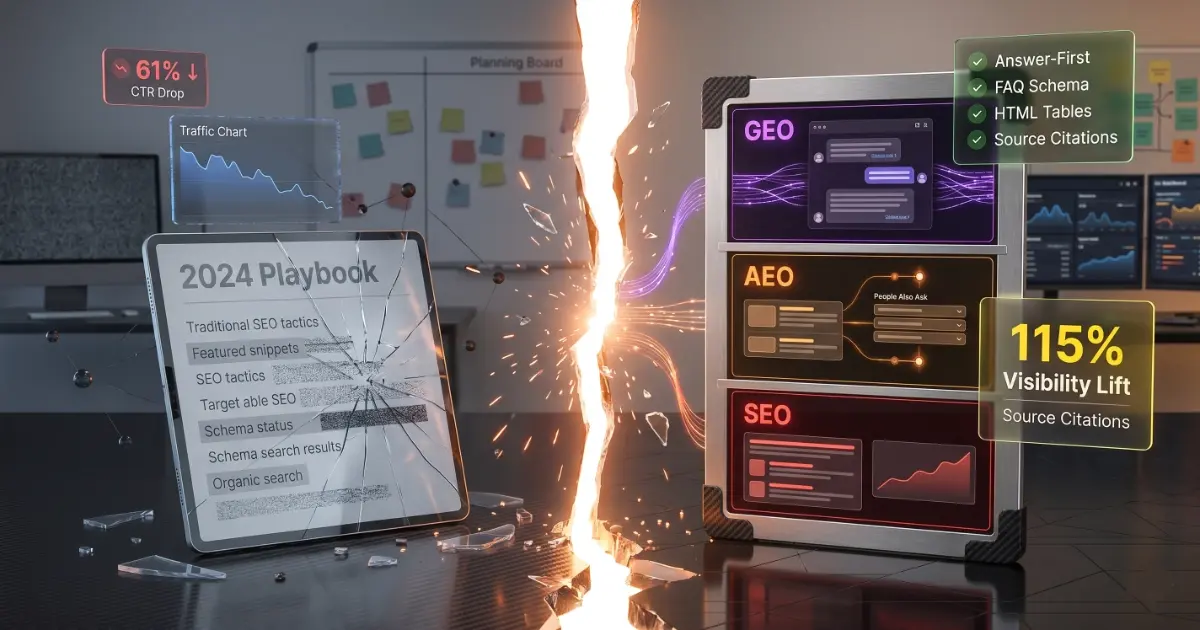
The problem is different. In the last 18 months, search has split into three visibility channels. SEO is still the foundation. But it's not the whole game anymore. Two new layers are sitting on top of it, and they have their own rules. Real estate keywords triggering AI Overviews grew 258% in a single quarter in early 2025. The builders losing ground in 2026 aren't failing at SEO. They're running a 2024 playbook that ignores two of the three channels and isn't formatted properly for the one it's targeting.
Three channels. One content architecture that serves all three. The mechanics are specific and well-documented. Most builder sites don't have any of them.
Search has split into three visibility channels.
Search visibility in 2026 requires presence across three distinct channels: traditional SEO (blue-link organic rankings), Answer Engine Optimization or AEO (featured snippets, People Also Ask boxes, AI Overviews), and Generative Engine Optimization or GEO (ChatGPT, Perplexity, Claude, and other AI-powered search platforms). The same content architecture can serve all three, but only if it's built for all three from the start.
Here's what each one means in plain English.
SEO is the blue links. The organic search results you've been optimizing for since 2010. Still the backbone of search traffic.
AEO is the answers above the blue links. When Google pulls a featured snippet, populates a People Also Ask box, or generates an AI Overview at the top of the results page, that's answer engine territory. Your content is either structured to be extracted into those boxes or it isn't.
GEO is the citation inside an AI assistant's response. When a buyer asks ChatGPT "what should I look for in a new construction contract?" and it summarizes an answer from three sources, those three sources earned a GEO citation. If yours isn't one of them, you're not in the conversation.
This isn't an either/or. Google still dominates raw traffic volume. But here's what happens when a buyer searches "how much does it cost to build a house in [your city]" in 2026: they might see an AI Overview at the top consuming most of the screen, a People Also Ask block, two paid results, a local pack, and only then the first organic blue link. Each of those surfaces is a separate game with its own rules.
The part most builders haven't internalized: the same content can serve all three channels if it's structured properly. This is not three separate workstreams. It's one content architecture with mechanics that satisfy all three engines at once.
Let me walk through what's broken in each channel and what the new playbook actually requires.
SEO itself changed under your feet.
Traditional SEO didn't die, but the rules changed dramatically in the last 18 months. Between 58% and 69% of all Google queries now end without a click. AI Overviews appear in up to 50% of mobile search results. Seer Interactive's 15-month study of 3,100+ queries across 42 organizations found organic CTR dropped 61% on queries where AI Overviews appear. Position 1 still matters. But only if you're built to be extracted.
The screen real estate problem alone should get your attention. When AI Overviews show up, they consume 75.7% of mobile screen space and 67.1% of desktop. Google's AI Mode runs a 93% zero-click rate. Your number-one ranking is still there. It's just buried under a wall of AI-generated content that most users never scroll past.
Here's the reframe that matters: ranking number one is more important than ever. Not because of the click-through rate from that position, which has cratered. Because position one is the most likely position to be extracted into an AI Overview or featured snippet. The traffic from ranking first isn't what it was. The visibility from being cited from position one is now where the leverage sits.
For builders, this hits especially hard. Cost queries, process queries, "best builder in [city]" queries. Those are exactly the ones triggering AI Overviews. Content optimized only for traditional click-through is bleeding visibility on every single one of them.
AEO is the layer most builders have never optimized for.
Answer Engine Optimization is the discipline of structuring content so Google can extract it into featured snippets, People Also Ask boxes, and AI Overviews. The mechanics are well-documented: answer-first paragraphs of 40 to 60 words, FAQ sections with FAQPage schema, HTML comparison tables, and question-format headings. Most builder sites have none of these.
Start with the schema gap. 73% of Google's page-one results use schema markup. 88% of all websites don't implement any. That's the single biggest leverage point most builders are leaving on the table.
The competitive window here is wide open. Most home builder websites still lack FAQ schema, HowTo schema, answer-first content structure, and structured cost data. Even Blue Tangerine, one of the largest builder-focused marketing agencies, didn't publish AEO/GEO guidance until October 2025. The industry is behind.
The mechanics that actually move the needle:
Answer-first paragraphs. Every H2 in your content needs a 40 to 60 word direct answer immediately below it. Paragraph snippets account for roughly 70% of all featured snippets. If your content buries the answer under three paragraphs of context, Google skips you and cites someone who leads with the answer.
FAQ sections. Five to eight questions with 40 to 80 word answers, marked up with FAQPage schema. "Why" questions generate paragraph featured snippets 99.96% of the time.
HTML tables. Tables with descriptive headers earn 47% higher AI citation rates than content without them. If you're publishing comparison content as an image or a PDF, AI can't read it. Period.
Clean heading hierarchy. Pages with clear H2/H3 structure and aligned schema are 40% more likely to be cited by AI engines. Pages that go four or five heading levels deep confuse the extraction.
For builders, three AEO opportunities are sitting wide open right now.
Cost content. "How much does it cost to build a house in [city]" queries are dominated by Rocket Mortgage, Angi, and HomeLight. National platforms with no local data. Local builders with real local cost data and proper content structure can outrank them. It's not even close.
Process content. "How to build a custom home" content with HowTo schema and step-by-step structure wins AI citations. Most builder "Our Process" pages are a six-step graphic with no text. That's invisible to every AI engine.
Best-builder recommendations. AI systems already recommend specific builders for "best builder in [city]" queries. Almost no builders are positioned to win them.
The payoff for getting this right: brands cited in AI Overviews earn 35% more organic clicks and 91% more paid clicks than non-cited brands. That's not a marginal improvement. That's a different category of performance.
GEO is where the compounding advantage gets built.
Generative Engine Optimization is how content earns citation inside AI assistants like ChatGPT, Perplexity, Claude, and Google's AI Overviews. The Princeton GEO study, published at KDD 2024, tested nine optimization tactics across 10,000 queries. Three worked across the board: citing sources (115% visibility lift), adding quotations (37%), adding statistics (22%). Keyword stuffing performed 10% worse than baseline. The old SEO reflex of cramming keywords into every paragraph actively harms GEO performance.
The volume here is not small. ChatGPT processes over 1 billion queries daily across 800 to 900 million weekly active users. Perplexity handled 780 million queries in May 2025 alone, up 239% from August 2024. Google AI Overviews reach 2 billion monthly users across 200+ countries. AI-referred traffic grew 527% year-over-year between January and May 2025.
But volume is just the setup. The conversion punchline is the real headline. AI search visitors convert at 4.4 to 23 times the rate of traditional organic search visitors. Ahrefs found AI search visitors make up just 0.5% of total traffic but drive 12.1% of signups. These visitors don't browse. They've already decided what they need. They click through with intent.
Each platform cites differently. 87% of ChatGPT citations match Bing's top 10 organic results. Perplexity leans heavily on Reddit (46.7% of citations) and YouTube (13.9%). 93.67% of Google AI Overview citations link to at least one top-10 organic result. And here's the number that makes the multi-platform case: 86% of top-mentioned sources are not shared across ChatGPT, Perplexity, and Google AI features. Visibility on one platform doesn't mean visibility on the others.
One more data point that changes how you think about content maintenance. 76.4% of ChatGPT's most-cited pages were updated in the last 30 days. LLMs show a recency bias, shifting citations by as much as 95 ranks toward newer content. Content has to be maintained, not just published. A blog post from 2023 with no updates is a ghost in the AI citation landscape.
The compounding point is this: every cited statistic, every primary source, every well-structured FAQ block is a citation hook. Build them now, and the engines find you faster than competitors who start later. Builders who optimize for GEO in 2026 are building a citation moat that gets harder to close once their content is in the training set.
The new playbook is one content architecture, three channels.
Most builders aren't publishing enough content to begin with. But publishing more of the wrong kind won't fix this. The fix is building content that satisfies all three channels at once. Every post needs answer-first paragraphs, an FAQ section, schema markup, cited statistics, HTML tables for any comparison, and an author byline with credentials. These mechanics aren't optional in 2026. They're table stakes.
Stop thinking about content as a tactic. Start treating it as infrastructure that powers three visibility channels simultaneously. This connects directly back to what I laid out in the first article of this series. Content as infrastructure. Not a marketing activity you do when you have time. The substrate the entire buyer journey runs on.
The non-negotiable mechanics for every blog post in 2026:
Answer-first paragraph of 40 to 60 words under the H1 and every H2 heading. FAQ section with 5 to 8 questions, 40 to 80 word answers, and FAQPage schema. HTML tables for any comparison content, never image-based tables. One to two specific data points per section with full URL citations. Author byline at the top, full bio with credentials at the bottom. "Last Updated" timestamp in the byline. 8 to 15 images per post placed before H2 headers. Schema markup at minimum: Article plus FAQPage, with HowTo or HomeAndConstructionBusiness where applicable.
The cost of skipping any single one of these is lost visibility on at least one channel. Skip the answer-first paragraph, and you lose AEO. Skip the FAQ schema, and you lose AI citations. Skip the source citations and the 115% visibility lift that the Princeton study documented goes to the competitor who cited their sources.
The competitive window reality is straightforward. Builders who structure their content properly in 2026 capture disproportionate AI visibility in their local markets before the rest of the industry figures out what changed. This advantage is temporary. Six months from now this stops being an edge and becomes the baseline. Right now, most builders aren't doing any of it.
And here's Google's own position on the matter: "There are no additional requirements to appear in AI Overviews or AI Mode." Standard SEO best practices plus clean structured data is the path. The builders who do this in 2026 win visibility their competitors can't recover quickly.
So the choice is clear. An in-house team writing two posts a month with no schema, no FAQs, no answer-first paragraphs, no cited statistics. Or content built to the spec the engines actually use. One of those builds a moat. The other one gets buried.
SEO isn't dead. The 2024 playbook is. The new playbook is one content architecture serving SEO, AEO, and GEO at the same time. The mechanics are specific. They're documented. They're not hard. Most builders just haven't done them yet.
The window is open. Builders who build their content to this spec in 2026 win visibility their competitors can't recover quickly. The competitive gap compounds month over month as AI engines learn to cite your content first.
There's one part of this nobody in the industry wants to say out loud. Most agencies still selling SEO services in 2026 aren't building this kind of content. They're not even close. Next article: why the traditional agency model can't make this shift, and what it means for who you should be paying.
Next one drops in a few days.
- Jeff, Founder, Velocity23
Read the full series:
-
4 Things That Broke About Home Builder Marketing in the Last 12 Months
-
The Buyer's Journey Isn't Linear Anymore. Here's What It Actually Looks Like in 2026.
- Here's What We Built
Frequently Asked Questions
Is SEO still worth doing in 2026?
Yes. Google processes 8.5 billion searches daily, holds roughly 95% of search market share, and sends 345 times more traffic to websites than all AI chat platforms combined. SEO is still the foundation. What's changed is that SEO alone isn't enough. Content now needs to be structured for AEO and GEO simultaneously to capture visibility across all three channels.
What's the difference between AEO and GEO?
AEO (Answer Engine Optimization) targets Google's own answer features: featured snippets, People Also Ask boxes, and AI Overviews. GEO (Generative Engine Optimization) targets citation inside third-party AI assistants like ChatGPT, Perplexity, and Claude. AEO is about being extracted by Google. GEO is about being cited by AI platforms that pull from the open web.
How is an AI Overview different from a featured snippet?
A featured snippet pulls a direct quote or summary from a single webpage and displays it at the top of search results. An AI Overview is generated by Google's AI, synthesizing information from multiple sources into a conversational answer. AI Overviews consume significantly more screen space (75.7% on mobile) and can cite multiple sources in a single response.
Do I need to choose between SEO, AEO, and GEO?
No. That's the entire point. The same content architecture serves all three channels when it's structured properly. Answer-first paragraphs serve AEO. Cited statistics serve GEO. Clean heading hierarchy and keyword optimization serve SEO. One piece of content, built to spec, earns visibility across all three simultaneously.
What's the highest-impact change I can make to my existing content for AI visibility?
Add source citations to every statistic in your content. The Princeton GEO study found that citing sources produces a 115.1% visibility increase in AI engines. It's the single highest-impact tactic tested, and most builder content cites nothing. Second priority: add answer-first paragraphs of 40 to 60 words under every H2 heading.
How long does it take to see results from AEO and GEO?
AEO results can appear within weeks of content restructuring, especially for featured snippets and People Also Ask boxes on queries you already rank for. GEO results depend on crawl frequency and platform. Google AI Overviews pull heavily from existing top-10 organic results. ChatGPT citation depends on Bing indexing. Content freshness matters significantly: 76.4% of ChatGPT's most-cited pages were updated in the last 30 days.
Does AI search traffic actually convert?
At rates that make traditional organic look modest. AI search visitors convert at 4.4 to 23 times the rate of traditional organic visitors. Ahrefs data shows AI search visitors account for 0.5% of total traffic but drive 12.1% of signups. These visitors arrive with high intent because they've already refined their question through a conversational AI interface before clicking through.